How to Choose a Commercial Frozen Meat Slicer
Choose a commercial frozen meat slicer rated for the condition of your meat and the amount you need to slice. Check whether it supports frozen or semi-frozen food, then match its capacity, blade, thickness range and cleaning needs to your workflow.
On this page (5 sections)
A commercial frozen meat slicer should match the food’s frozen condition and your batch size. Confirm that the machine is intended for frozen or semi-frozen products, then compare tray capacity, blade size, thickness control, cleaning and the expected workload.
“Frozen” can mean partly firm or frozen solid, and those are different jobs. Check the manufacturer’s directions for the condition of meat you plan to slice before buying.
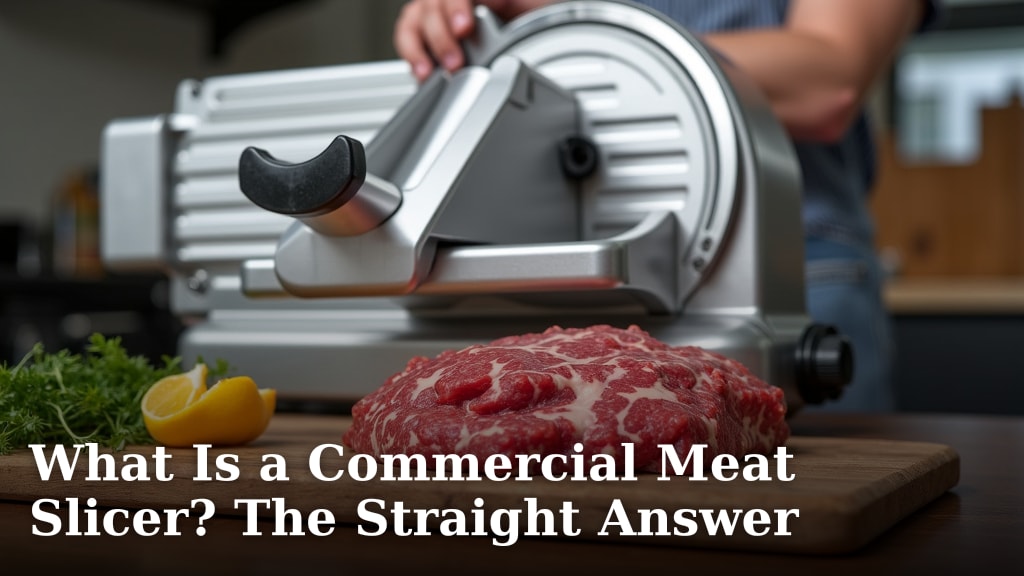
For context on equipment intended for food service, start with What Is a Commercial Meat Slicer? The Straight Answer.
A commercial label by itself does not tell you whether a slicer can cut fully frozen meat.
What should you check in a commercial frozen meat slicer?
Check the food condition, workload and usable capacity first. Then compare the blade and thickness range, stability, cleaning access and service details.
A slicer may suit semi-frozen food but not frozen-solid cuts. If the manufacturer describes only fresh meat or general slicing, ask for clarification before using it on frozen food.
| Check | Why it matters | What to confirm |
|---|---|---|
| Frozen food rating | Food condition affects whether the machine is suitable | Whether it supports frozen, semi-frozen or only fresh foods |
| Batch capacity | Tray space and workload affect how much you can process | Maximum food dimensions and expected batch size |
| Motor and duty | Repeated work places demands on the machine | Intended use and any operating or rest guidance |
| Blade and thickness | The cut you need must fit the machine’s range | Blade diameter and adjustable thickness settings |
| Stability and handling | Movement can make feeding food harder to control | Base, carriage, hand guard and food support |
| Cleaning and service | Food residue and wear need attention | Removable parts, cleaning directions and replacement-part support |
Capacity is more than the motor’s wattage. Compare the dimensions of your largest cut with the food tray, and consider how often you will need to pause to clean or reload.
Does a commercial frozen meat slicer need a special rating?
Yes, you should confirm the allowed food condition directly. A slicer described for commercial use may still have limits on what it can cut.
Look for clear guidance about frozen or semi-frozen meat, including any preparation steps. If the information does not say what you need, contact the manufacturer before using the machine on that food.
Do not infer frozen-food capability from wattage, blade diameter or a “heavy duty” label. Those details help compare machines, but they do not guarantee the safe operating conditions.
How much capacity do you need?
Choose a slicer that can support the dimensions of your largest cut and the volume of your busiest session. Check the tray size and the manufacturer’s stated capacity, then compare them with your actual work.
A small counter-service kitchen that slices a few portions at a time has a different workload from a shop processing large batches. Plan for the busiest normal day rather than an occasional peak that may never happen.
Also account for handling space. Large cuts can be awkward to position, so a roomy tray and secure carriage may matter as much as a high motor rating.
Which slicer features matter for frozen meat?
The most useful features are the ones that suit your required cut and repeated workflow. Blade size, thickness control, stable food support and cleanable parts each solve a different problem.
A larger blade does not automatically mean higher capacity. Confirm the food dimensions the slicer accepts and whether its instructions cover your meat’s frozen state.
What blade and thickness range should you look for?
Match the blade and thickness control to the size of the cut and the slices you need. A broad adjustment range helps with varied portions, but the slicer must also support the food’s condition.
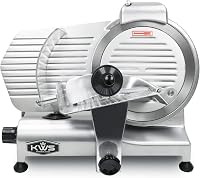
For example, the KWS KitchenWare Station 10NS has a 10-inch stainless steel blade and an adjustable thickness dial from paper-thin to 14 mm. KWS says it can handle semi-frozen products and recommends partially freezing meat to –4°C for ultra-thin cuts.
Before choosing it for a frozen-food workflow, confirm that “semi-frozen” matches your intended cuts. Do not assume that guidance for partially frozen meat also covers meat frozen solid.
The best commercial meat and cheese slicers guide can help if your workload also includes firm cheeses. Check each machine’s own food guidance before using it for frozen meat.
How do motor and duty cycle affect the choice?
Motor power is one comparison point, not a frozen-food rating. A stronger motor may be relevant to a demanding workflow, but it cannot replace manufacturer guidance about the food and operating time.
The KWS 10NS lists a 320W motor and is described for continuous slicing of meat, cheese and semi-frozen products. Its information also describes it for light commercial settings, so match that stated use to your own volume rather than assuming it suits every commercial operation.
The Cuisinart Kitchen Pro lists a 130W motor and a 7.5-inch stainless steel blade. It is described for meats, cheeses, vegetables and bread, but the available product details do not mean it is suitable for frozen meat.
For broader buying criteria, see How Do You Choose an Electric Meat Slicer? Worth Knowing.
Compare intended use and food condition along with power.
How important are cleaning and service access?
Cleaning access matters because the food-contact parts need care after each session. Look for removable parts and clear cleaning directions, then consider how easily you can reach the surfaces that need attention.
The KWS 10NS has a removable carriage, hand guard, blade and blade cover. Its care instructions say to hand wash.
KWS also describes replacement parts and service support as available.
The Cuisinart Kitchen Pro has a removable blade, food guide and stainless steel carriage, with hand washing listed for care. Follow each machine’s instructions for handling and cleaning its blade.
Which options fit different slicing tasks?
Choose based on the job the tool is designed to do. A countertop slicer supports adjustable portions, while an electric carving knife is built around carving tasks and should not be treated as a frozen-meat slicer without manufacturer guidance.
Is a countertop slicer right for repeated portions?
A countertop slicer can make sense when you need repeatable thickness settings and a supported carriage. Check the food guidance and tray dimensions before matching one to frozen meat.
The KWS 10NS is the clearest match among these options for semi-frozen meat because its stated uses include semi-frozen products. Its tray accommodates food up to 7 inches long, 7.5 inches wide and 5.5 inches high.
It weighs 37 lb, so plan for a stable countertop location and enough room around the carriage. Its built-in sharpener allows touch-ups, according to KWS.
If you need a more demanding commercial setup, compare models in Best Heavy Duty Commercial Meat Slicers. Verify frozen-food guidance for the specific model you choose.
Is an electric carving knife suitable?
An electric carving knife suits carving cooked foods such as turkey, chicken, ham and roast, based on the NutriChef’s stated uses. That does not make it a commercial slicer or establish suitability for frozen meat.
The NutriChef is a handheld knife with a safety lock and a wooden storage stand. Consider it for carving tasks if those match your needs, but choose a slicer with explicit frozen-food guidance for frozen cuts.
How should you prepare meat for slicing?
Prepare meat only as the slicer manufacturer directs. Food that is partly firm may be easier to handle for thin slices, but the machine’s instructions set the limit.
KWS recommends partially freezing meat to –4°C for ultra-thin cuts on the 10NS. This is model-specific guidance, not a general instruction for every slicer or every type of frozen meat.
Use the food guard and carriage as directed, and keep hands clear of the blade. Stop if the meat shifts or the machine struggles, then follow its manual for safe clearing and restart steps.
If you freeze meat ahead of time, package it for storage and label it with the cut and date. Our vacuum sealer vs freezer bags guide compares storage choices for frozen food.
How do you choose the right machine for your kitchen?
Choose a commercial frozen meat slicer only when its stated food rating and capacity match your task. If the machine is described only for semi-frozen food, do not treat that as approval for fully frozen meat.
Use this quick sequence:
- Write down whether you need to slice partly firm, semi-frozen or fully frozen meat.
- Check the manufacturer’s directions for that exact food condition.
- Measure the largest cut and compare it with the tray or carriage dimensions.
- Estimate your usual batch size and how often you will slice.
- Compare thickness range, blade size, stability and cleaning access.
- Confirm any operating limits and service support that affect your workflow.
For a small or occasional workload, avoid buying more machine than your use requires. If the frozen-food guidance is unclear, ask the manufacturer before choosing.
For equipment intended for commercial use, begin with What Is a Commercial Grade Meat Slicer? A Beginner’s Guide.
Pick the KWS 10NS when its semi-frozen guidance and tray fit your task; choose another machine only after confirming its rating and capacity for your cuts.
Frequently asked questions
Can a commercial meat slicer cut frozen meat?
Some slicers are intended for semi-frozen food, while others are described for fresh meat and firm foods. Check the exact food condition the machine supports and follow its instructions.
A slicer’s motor power or commercial label alone does not confirm that it can cut fully frozen meat.
Should meat be frozen before slicing?
Partially firm meat can be easier to slice into even portions, but the right condition depends on the machine and the cut. Follow the slicer’s instructions for frozen or semi-frozen food.
KWS recommends partially freezing meat to –4°C for ultra-thin cuts on its 10NS.
What capacity should a commercial frozen meat slicer have?
Choose capacity based on your largest expected batch and how often you slice it. Check the size of the food tray and the maximum food dimensions, then consider the time between batches and cleaning.
A motor rating alone does not tell you how much frozen food the slicer can handle.
Is a meat slicer or electric carving knife better for frozen meat?
A countertop meat slicer is the more relevant tool to consider for repeat, adjustable slices, but only if the manufacturer supports the food’s frozen condition. An electric carving knife is designed for carving foods such as cooked turkey, ham and roast, so check its intended use before considering it for frozen meat.